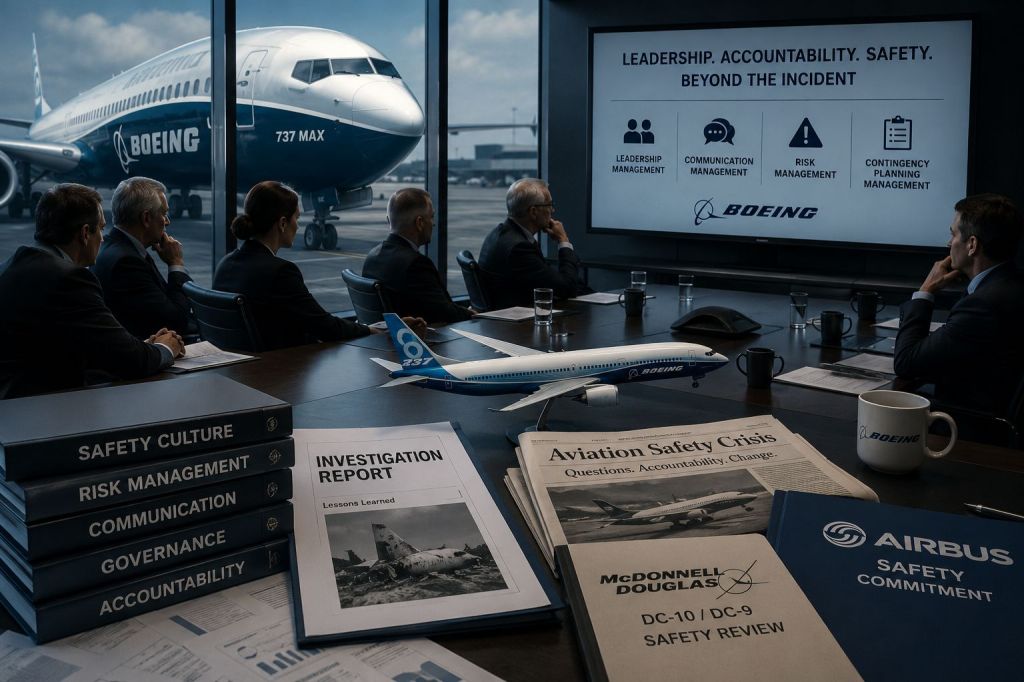
A recent post by Coach Norah AlDhubaiban about the Boeing incident and investigation, which I came across, triggered an important reflection around leadership, risk, communication, and organizational listening.
What was highlighted in her article goes far beyond the incident itself.
When we look deeper into cases like Boeing, or other cases that surfaced within the industry, we begin to see larger questions around leadership, communication, risk awareness, and organizational culture.
What followed the investigations and organizational reviews pointed toward several critical leadership and management challenges:
- Leadership Management
- Communication Management
- Risk Management
- Contingency Planning Management
The Boeing case remains one of the most significant cases in the history of aviation leadership and corporate management. However, unfortunately, it was not the first.
Years earlier, during the 1970s, 1980s, 1990s, and early 2000s, both Airbus and McDonnell Douglas faced serious legal allegations and operational crises related to aircraft safety and accident investigations.
One of the most well-known examples involved McDonnell Douglas and its aircraft models, the DC-10 and DC-9, which were involved in approximately 55 accidents resulting in 32 hull losses that claimed 1,261 lives during the 1980s. These aircraft, originally developed by Douglas Aircraft Company before the 1967 merger, experienced fatal accidents associated with early design concerns, maintenance failures, operational oversight, and, in some cases, environmental and weather-related factors. The DC-10, in particular, suffered from major reputational and safety challenges during critical periods of its operational history.
Having mentioned an aviation case, honestly, this is not only about aviation.
We see similar patterns in banking, healthcare, corporations, engineering, power industries, and even in our daily professional environments.
These cases continue to raise one important question:
Have organizations truly activated their listening mechanisms?
Are organizations really listening? Not hearing… but truly listening.
Have they genuinely built effective bridges of communication?
Are they understanding the concerns, feedback, and warnings coming from people inside and outside the organization?
Sometimes the biggest risks are not technical failures. Sometimes it is leadership blind spots that close our eyes, and we act as if we do not want to witness, observe, or visualize the reality around us…
The following questions remain among the most debated and often ignored leadership questions that we keep asking ourselves:
- Are we truly listening?
- Are we adapting?
- Are we genuinely understanding the people, stakeholders, and communities we deal with?
When organizations fail to listen, communicate, and understand, the consequences often lead to legal allegations, reputational damage, operational collapse, bankruptcy, or significant business loss.
Leadership is not only about decision-making. It is about awareness, accountability, communication, and the courage to listen before crises emerge and problems become disasters.





Leave a Reply